Commercial Air Conditioning Installation
Turnkey commercial climate systems — from single-shop cassettes to multi-storey VRF — designed, installed and commissioned to CIBSE guidance.
From £4,500 per zone
Fixed-price quote, held to the day.
3–15 days depending on scope
Typical timeline from survey to commissioning.
5-Year Warranty
Parts and labour covered on every install.
F-Gas Certified
REFCOM-registered engineers on every job.
- Minimal downtime — evening & weekend installs
- BMS-ready with Modbus, BACnet or KNX gateways
- Fresh-air integration and MVHR interlocks
- F-Gas record keeping and annual leak testing
Why choose this
- Minimal downtime — evening & weekend installs
- BMS-ready with Modbus, BACnet or KNX gateways
- Fresh-air integration and MVHR interlocks
- F-Gas record keeping and annual leak testing
What's included
- Heat-load design to CIBSE Guide A
- Ceiling cassette, ducted or VRF architecture
- Roof/plant-deck condenser positioning
- Fire-stopping through compartment walls
- Commissioning to BSRIA BG 49 and F-Gas 517/2014
System types for commercial spaces
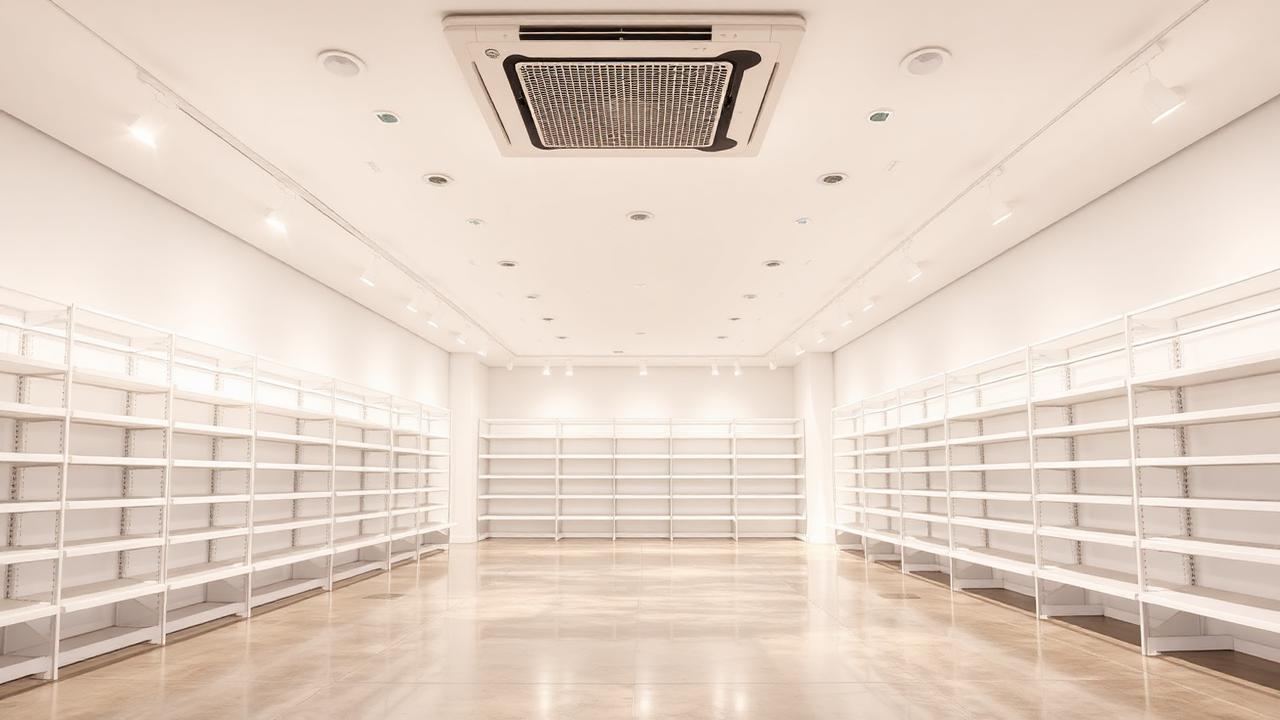
For single-tenant retail units under 100 m² we usually specify a 4-way ceiling cassette (5.0–14 kW) with a single outdoor condenser. Restaurants and gyms with higher latent loads move to ducted units paired with fresh-air interlocks. Anything above 200 m² or across multiple zones is a candidate for VRF — one condenser can drive up to 64 indoor units with individual set-points and simultaneous heating/cooling on 3-pipe systems.
Hospitality venues — hotels, bars and restaurants — increasingly favour concealed ducted units above bulkheads with linear slot diffusers, avoiding the visible cassette look while still delivering per-zone control. For gyms and fitness studios we combine high-capacity ducted cooling with fresh-air interlocks and dehumidification, because the latent load from occupants can exceed the sensible cooling requirement.
Design, install, commission
Every commercial project starts with a CIBSE-compliant heat-load calculation covering occupancy, IT/kitchen equipment, solar gain and fabric U-values. We produce a full drawing pack (pipe runs, electrical schedule, condenser structural loading) for landlord and building-control sign-off. Installation is scheduled around trading hours; final commissioning includes a BSRIA-format report, refrigerant log and PPM handover pack.
Our design team uses Trimble AutoCAD, Daikin Xpress and Mitsubishi MelcaDesigner to produce coordinated M&E drawings compatible with your architect's Revit model. Clash detection with structure, lighting and sprinklers happens before we cut a single tile — saving programme days and avoiding the change-order arguments that plague poorly planned fit-outs.
Ongoing compliance
Systems containing 5 tCO₂e or more of F-Gas require statutory annual leak checks (Regulation EC 517/2014). We hold the F-Gas company certificate and can operate as your Responsible Person, keeping records for HMRC and Environment Agency inspection.
We also cover TM44 air conditioning inspections, which are mandatory every five years for systems above 12 kW rated cooling output. Our TM44 assessors are CIBSE Low Carbon Consultant certified and lodge the report on the Landmark register within 48 hours of survey — avoiding the £300–£1,000 fines that come with missed deadlines.
Working around your trading hours
Retail, hospitality and mixed-use fit-outs cannot afford a Monday-to-Friday nine-to-five installation window. We routinely deliver commercial projects in evening slots (18:00–02:00), Sunday shutdowns and week-long trading closures. Overnight work commands a modest 10–20% uplift which we itemise transparently at quotation.
For high-street retail we set up a dust-sealed working zone with negative-pressure filtration so the shop floor reopens each morning without residue. Every night's work ends with a photo report to your operations team — you know exactly what state the site was left in before staff arrive.
BMS and controls integration
Modern commercial buildings run on integrated controls. We supply BACnet/IP, Modbus RTU, KNX and LonWorks gateways for every major AC manufacturer, allowing your existing BMS to schedule occupancy, monitor faults and log energy consumption at zone level. For smaller sites without a BMS we offer manufacturer cloud platforms (Daikin Cloud Plus, Mitsubishi MELCloud Commercial) which deliver the same functionality via a browser.
Occupancy-linked control alone typically saves 15–25% on annual HVAC energy — turning zones off when meeting rooms empty, ramping down retail floors after closing and preventing the classic 3am compressor cycle when a thermostat drifts.
Case example: 220 m² retail unit
A recent central London menswear store needed cooling for a 220 m² sales floor with 8 m frontage of south-facing glazing. Our design used three 5 kW 4-way cassettes on a single 14 kW Daikin VRV outdoor unit, condenser mounted on a roof plinth with vibration isolators. Installation ran over four Sunday shutdowns during landlord-approved trading closures — no lost trading days.
Commissioned load: 15 kW. Measured summer running cost across peak July/August: £42 per week. Store manager satisfaction survey after twelve months: 4.8/5, with staff highlighting the near-silent operation compared with the wall-mounted units the previous tenant had left behind.
Landlord dilapidations and lease compliance
Any commercial AC install needs landlord consent under the vast majority of UK commercial leases. We produce a compliant landlord pack including drawings, structural loading calculations for condenser positions, refrigerant risk assessment (BS EN 378), acoustic assessment against neighbouring properties, F-Gas certification and installer insurance certificates. This pack typically satisfies landlord agent requirements in one submission — saving weeks of iteration.
At lease end we handle full or partial reinstatement to the exact standard specified in the lease. Common terms range from 'remove equipment, make good' (a straightforward decommission) to 'reinstate to shell and core' which requires plaster patch, floor reinstatement and full electrical isolation certification. We quote reinstatement upfront so the future obligation is known and provisioned.
Fresh air, CO₂ and healthy indoor environments
Post-2020 tenant expectations for indoor air quality have shifted dramatically. CO₂ monitoring is now standard rather than premium — clients expect real-time CO₂ visibility linked to fresh-air ramp control. We integrate wall-mounted CO₂ sensors with the ventilation system so fresh-air rate steps up automatically when occupancy pushes CO₂ above 800 ppm.
For food service and hospitality specifically, HEPA filtration and ionisation (bipolar or PECO) options are increasingly demanded. We offer these as add-on modules to any commercial cassette or ducted install — retrofit within existing units is generally possible without ductwork changes.
Programme integration with fit-out contractors
On multi-trade fit-outs we integrate with the main contractor's programme at RIBA Stage 3. Our fit-out schedule commits to mechanical first-fix within an agreed window (typically 6 weeks from award), enabling ceiling grid, sprinkler and lighting first-fix to proceed on their planned dates. Second-fix and commissioning slot into the standard fit-out programme window (typically weeks 10–12).
We also handle the interfaces that always cause delay on split-trade projects — electrical supply from the main distribution board (with the electrical contractor), fire-stopping through compartment walls (with the fire protection subcontractor) and BMS integration (with the controls contractor). Single point of accountability means no finger-pointing when a snag arises.
Energy performance certificates and Minimum Energy Efficiency Standards
Commercial buildings must hold a valid EPC before being let, and from 1 April 2027 the minimum threshold rises from EPC E to EPC C for all new lettings, extending to all continuing lettings by 2030 (MEES regulations). Air conditioning contributes typically 20–30% of a commercial EPC score — the difference between an old R-410A system with SEER 4.5 and a modern R-32 VRF with SEER 8.2 can shift the certificate by a full letter grade.
We include EPC-impact modelling in every commercial replacement quote so landlords understand the compliance benefit alongside the operational savings. The MEES exposure — inability to let after 2027 — is often larger than the AC replacement cost itself, transforming the payback calculation. Our energy consultants deliver the pre-refurb and post-refurb EPCs so the improvement is officially captured on the Landmark register.
Coordinating with structural and fabric works
Rooftop or terrace-mounted condensers add point loads of 200–600 kg per plinth. On existing buildings we work with your structural engineer at RIBA Stage 3 to confirm loading is within the building's residual capacity — or design vibration-isolated steel goalposts spanning to loadbearing walls where the deck itself cannot take the additional load.
Internal ductwork routing needs equally early coordination. Ducts crossing compartment walls need fire dampers to Approved Document B; ducts through insulated ceilings need thermal continuity to preserve the building fabric performance and its EPC rating. All fire and thermal detailing is included in our Stage 4 drawings, saving the arguments that plague post-tender coordination.
Frequently asked questions
Will you work out of hours?+
Yes — most retail and hospitality installs are staged evenings, overnight or weekends. There is a modest uplift (10–20%) which we quote transparently.
Do I need landlord consent?+
Almost always. We provide the drawings, structural loading data and F-Gas certification landlords typically request.
Can you TUPE an existing maintenance contract?+
Yes. We inherit service history, refrigerant logs and any outstanding warranty claims.
Do you handle building control notification?+
Yes — for both Part L (energy) and Part P (electrical). Certificates are lodged and copies sent to you within 10 working days of commissioning.
What's the typical lead time?+
Design and quote in 5–10 working days, then 4–8 weeks for equipment delivery and install slot depending on brand and scope.
Do you offer post-completion service contracts?+
Yes — Silver (annual F-Gas check), Gold (bi-annual service + reactive callouts) and Platinum (SLA-backed with 4-hour response) tiers. Priced per outdoor unit.
What's your minimum project size?+
No minimum — we take single-cassette shopfronts as happily as 20-unit VRF fit-outs. Pricing is transparent regardless of scale.
Can you work under existing framework agreements?+
Yes — we are on several NHS, university and Local Authority frameworks. Details on request during tender.
Related services
Home Air Conditioning Installation
Whole-home cooling & heating with quiet inverter splits engineered for UK houses and flats.
Office Air Conditioning Installation
Discrete cassette and ducted systems that keep meeting rooms cool without wall-mounted eyesores.
Single Split Air Conditioning Installation
One indoor unit paired with one outdoor condenser — the most efficient way to cool a single room.

UK-Based Coordinators, 7 Days a Week
Our friendly team answers every call, message and booking request — day, night, weekends and bank holidays. No call centres, no bots, no waiting in a queue. Speak to a real coordinator who dispatches an F-Gas certified engineer fast.